

Motor Setup and ESC Calibration
The power sets sold today (motor plus ESC) do not support calibration and do not need it. For other motors and ESCs, run the calibration in the second half of this page first, then set up the motor throttle range and test the motors.
Motor throttle setup
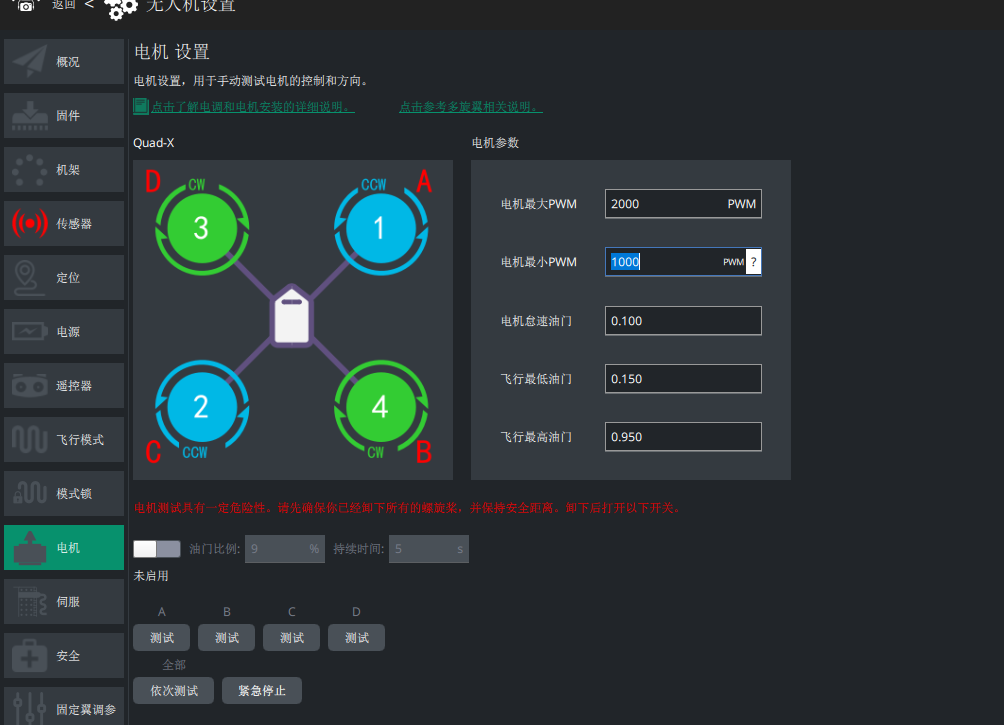
| UI field | ArduPilot parameter | Description | Notes |
|---|---|---|---|
| Max PWM | MOT_PWM_MAX | Highest PWM value sent to the motors | Default 2000; normally leave it alone |
| Min PWM | MOT_PWM_MIN | Lowest PWM value sent to the motors | Default 1000, which suits most brushless motors |
| Spin when armed | MOT_SPIN_ARM | Throttle percentage the motors idle at after arming | The percentage at which the motors just start turning, plus 2%; range 5%~10% |
| Minimum spin | MOT_SPIN_MIN | Lowest throttle percentage allowed in flight | 3% above spin when armed; range 8%~15% |
| Throttle max | THR_MAX | Highest throttle percentage allowed in flight | Default 0.95 (95%), so the throttle cannot saturate and overload the motors |
| RPM check | TKOFF_RPM_MIN | Takeoff only proceeds once motor RPM reaches this value | For aircraft with ESC telemetry |
WARNING
On high-KV machines running at low RPM, do not set spin when armed too high, and never set throttle max to 100% — it will damage the motors. 90%~95% is the normal range.
Motor test
WARNING
Take the propellers off before testing. A spinning propeller can cause serious injury.
TIP
Before testing, press the safety switch on the GPS until it stays lit, or disable the safety switch. Otherwise the system refuses to run the test. This test only covers the multirotor motors; on fixed-wing aircraft test the motor by hand in manual mode.
- Click the motor test button in the middle of the left panel to open the motor test area.
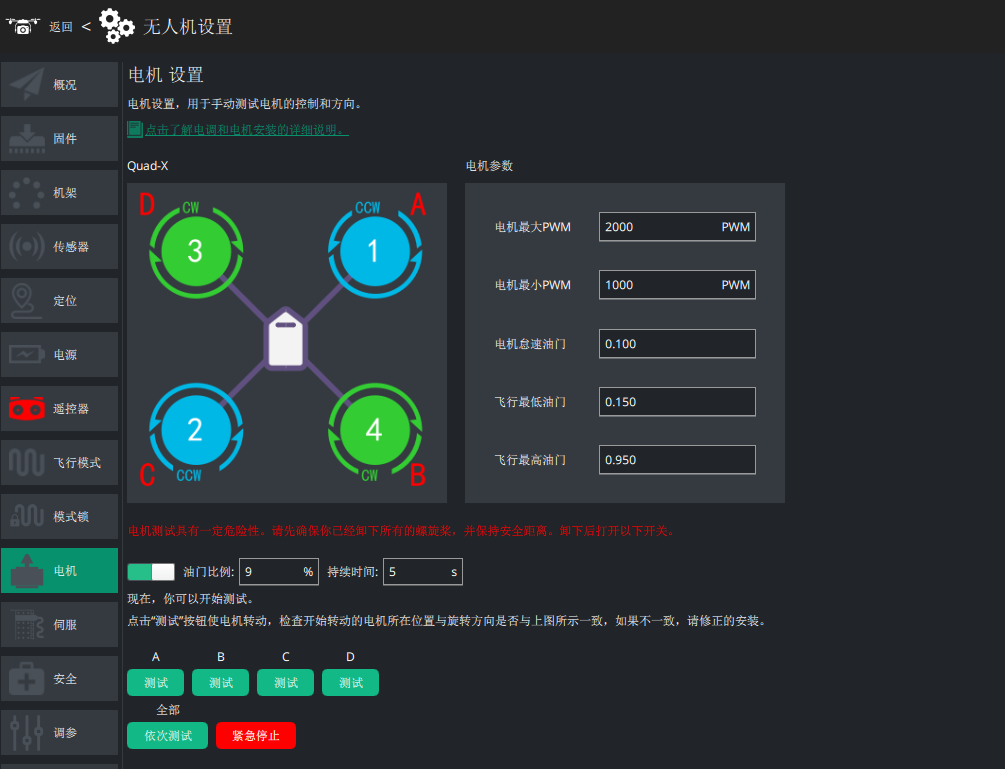
- The system shows the motor layout that matches your frame configuration.
- Set the throttle percentage and duration for the test.
- Click the test box under a motor number to spin that motor.
- You can also test them in sequence; the system then drives the motors in alphabetical order.
NOTE
The emergency stop button stops a multirotor immediately, but it does nothing to the lift motors of a VTOL fixed-wing aircraft.
The ESC drives each motor at the speed the controller asks for. Calibrating an ESC lines up the controller's output range with the ESC's input range. Today's power sets (motor plus ESC) do not support calibration and do not need it; for everything else, follow the steps below.
Before calibrating
- Make sure the ESCs are installed and their signal wires are plugged into the controller.
- Propellers must be off.
- Do not connect to the computer over USB.
- Check that the stick channels are not reversed.
Calibration steps
- Power on the transmitter and hold the throttle at maximum going into step 5.
- Plug the battery into the aircraft and release the safety switch. The PIX status LED should now cycle red, blue and yellow, which means the ESC has entered calibration.
- Unplug the battery, plug it back in. The LED keeps cycling — press and hold the safety switch immediately. A few seconds later it stays lit; release it.
- Wait for the ESCs to beep. The usual set of beeps reports the cell count (3 beeps for 3S, 4 for 4S, and so on), followed by two more beeps confirming that maximum throttle has been recorded.
- Pull the throttle to minimum. The motors should give one long beep, confirming that minimum throttle has also been recorded.
- Raise the throttle gently and check that every motor spins up and that they run together. If they do, calibration is done.
- Leave the throttle at minimum, disconnect the battery and finish.
Calibrating a single ESC
- Plug the ESC signal wire into channel 3 (throttle) on the RC receiver.
- Power on the transmitter and hold the throttle at maximum.
- Connect the battery to power the ESC.
- The motor plays a tone, then two beeps (check the ESC manual for the exact tones).
- After those two beeps, pull the throttle stick to minimum.
- You then hear several beeps (3 for a 3S battery, and so on), followed by one long beep confirming the throttle range is calibrated.
- Raise the throttle and check that the motor follows. If that works, repeat the same steps for every ESC.