

ESCs with Telemetry
An ESC with telemetry drives the motor and reports RPM, voltage, current and temperature from every ESC back to the controller in real time. A plain PWM ESC only receives commands and reports nothing, so the power system stays a black box; a telemetry ESC makes each motor observable and analyzable.
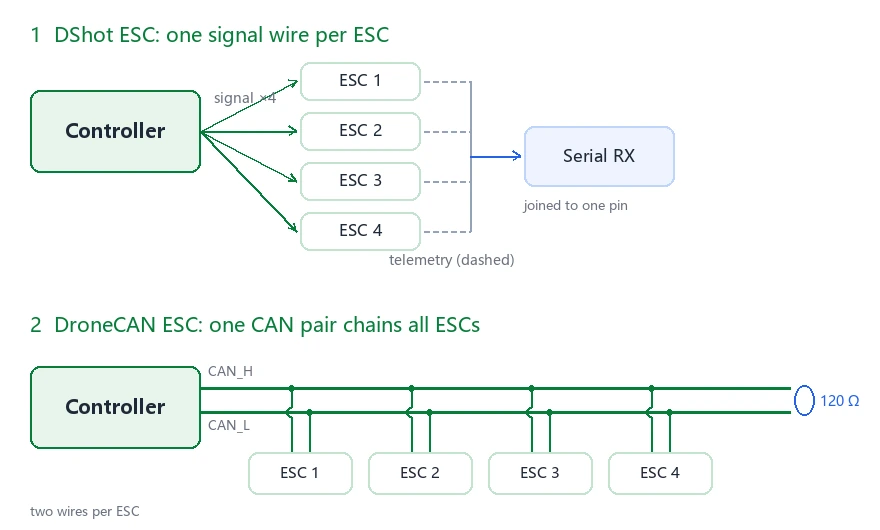
▲ Top: DShot digital ESCs, one signal wire each, telemetry merged into a serial port; bottom: DroneCAN ESCs, all ESCs chained on one pair of CAN wires
Two types
| Type | Link | What it reports | Characteristics |
|---|---|---|---|
| DShot digital ESC | Digital signal wire; telemetry on a separate wire into a serial port, or bidirectional DShot on the same wire | RPM; voltage, current and temperature depend on ESC firmware | Simple wiring, low latency, no throttle calibration |
| DroneCAN ESC | CAN bus, control and telemetry share one differential pair | RPM, voltage, current, temperature, power, error count | One bus carries many ESCs, least wiring |
One-line difference
DShot is point-to-point digital throttle plus telemetry; DroneCAN is a bus, and the same CAN pair can carry several ESCs along with other CAN devices.
What telemetry gives you
- Per-motor monitoring: which motor spins abnormally, which ESC runs hot, which channel draws too much current — all visible at a glance instead of guessed.
- Dynamic harmonic notch: use the reported motor RPM as the notch centre frequency so the filter tracks RPM changes in real time. It is cleaner than a fixed-frequency filter and clearly reduces attitude oscillation caused by vibration.
- No separate current sensor: set the battery monitor type to ESC telemetry (
BATT_MONITOR= 9) and the ESC voltage and current readings are aggregated into pack-level battery data. - Fault isolation and post-flight analysis: telemetry is written to the onboard log, so you can review the power system of every flight. ESCs with extended telemetry also record events such as stall and step loss.
- Simpler wiring and operation: CAN ESCs chain on one bus; DShot ESCs need no throttle range calibration.
How to choose
| Item | DShot digital ESC | DroneCAN ESC |
|---|---|---|
| Wiring | One signal wire per ESC (optional telemetry wire) | One CAN pair chained through all ESCs, terminator at the far end |
| Address / channel | Determined by the output channel, nothing to configure | Each ESC needs a unique ID mapped to its motor channel |
| Telemetry completeness | RPM is the most reliable; the rest depends on ESC firmware | RPM, voltage, current, temperature and power all available |
| Firmware update | Passed through and flashed by the controller | Usually needs the vendor's own tool |
| Typical use | Small and mid-size multirotors, weight-sensitive builds | Large multirotors with dense motor wiring |
Setup guides
- Hobbywing CAN power set: correcting the factory baud rate and IDs
- T-Motor DroneCAN power set: ID setup, firmware update and debugging notes
- DShot ESC setup: digital protocol, single-wire telemetry and bidirectional DShot