

Thruster and Servo Connections
Rover firmware points the rudder, throttle and sail at specific outputs through SERVOx_FUNCTION. Hulls differ, so the wiring falls into four cases: rudder servo, twin screw, vector thrust and sails. Pick the section that matches the boat and finish the wiring and parameters before launching.
Rudder steering
Most boats, like full-size vessels, keep rudder and propeller as two separate mechanisms: the steering servo drives the rudder on Output 1 (SERVO1), and the propulsion ESC drives the propeller on Output 3 (SERVO3).
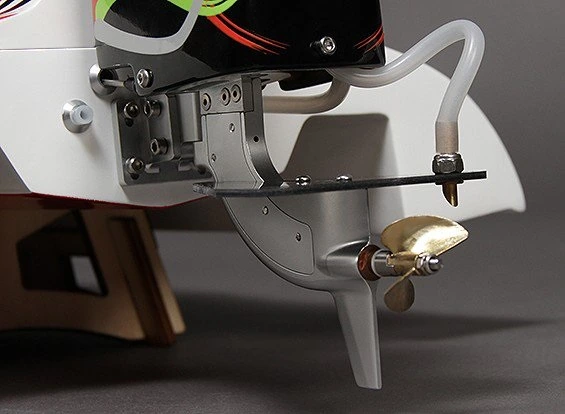
▲ Stern drive unit: propeller, rudder blade and servo linkage
| Parameter | Value | Notes |
|---|---|---|
SERVO1_FUNCTION | 26 | Ground Steering, steering |
SERVO3_FUNCTION | 70 | Throttle |
Both are the factory defaults and only need resetting if a channel was changed. If the rudder does not reach full travel, adjust SERVO1_MIN / SERVO1_MAX; if centre is off, adjust SERVO1_TRIM; if the boat turns left when you steer right, set SERVO1_REVERSED to 1.
With more than one thrust motor, each ESC takes its own output and all of them are set to 70: a second ESC on Output 2 means SERVO2_FUNCTION = 70, and so on. The x in SERVOx is the output number that ESC is plugged into.
Twin-screw differential
A twin-screw boat has no rudder and turns on the thrust difference between sides: the port drive goes to Output 1 and the starboard drive to Output 3.
| Parameter | Value | Notes |
|---|---|---|
FRAME_CLASS | 2 | Boat; 1 is ground vehicle, 3 is balance bot |
SERVO1_FUNCTION | 73 | ThrottleLeft |
SERVO3_FUNCTION | 74 | ThrottleRight |
Do not swap left and right
With 73 and 74 exchanged the boat still runs straight, but steering is inverted throughout: command a left turn and it turns right. Swap the channels instead of masking the wiring error with SERVOx_REVERSED.
Vector thrust
On a vector-thrust boat the steering servo carries the whole drive unit rather than a rudder blade: the servo still goes to Output 1 (SERVO1) and throttle to Output 3. Steering response at low speed is noticeably better than with a fixed thruster.
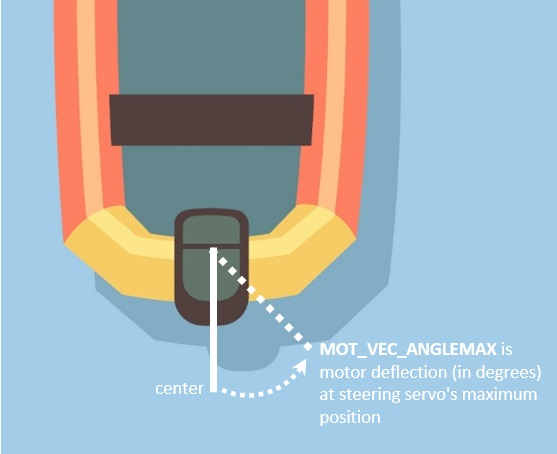
▲ Top view: `MOT_VEC_ANGLEMAX` is how far the drive unit swings off the centreline at full servo travel
| Parameter | Value | Notes |
|---|---|---|
MOT_VEC_ANGLEMAX | Per boat | 0~90°; 0 disables |
SERVO1_FUNCTION | 26 | Steering, swings the whole drive unit |
SERVO3_FUNCTION | 70 | Throttle |
Set the angle from the mechanical travel
Measure the angle the drive unit actually reaches from centre. A value larger than the mechanical travel leaves the servo stalled against its limit.
Sail winch
A boat with sails drives the sail actuator from its own output, and the function number depends on the sail type: a soft sail uses 89 to drive the winch, while a wing sail is either elevator-actuated or directly driven.
| Parameter | Value | Notes |
|---|---|---|
SERVOx_FUNCTION | 89 | Soft sail: Main Sail Sheet, winch sheets the sail in and out |
SERVOx_FUNCTION | 128 | Wing sail: Wing Sail Elevator, controls angle of attack |
SERVOx_FUNCTION | 137 | Wing sail, direct drive: Sail Mast Rotation, servo turns the mast |
Centre, travel and the SAIL_* group are covered in Sailboat mode.