

ArduPilot Plane / VTOL
ArduPilot Plane firmware covers fixed-wing aircraft, flying wings, gliders and VTOL (QuadPlane) types. They share the same controller and ground station; what differs is the aerodynamic layout and the way they take off. Before choosing, weigh what a fixed wing buys you and what it costs, then see what VTOL adds on top and what it adds in turn.
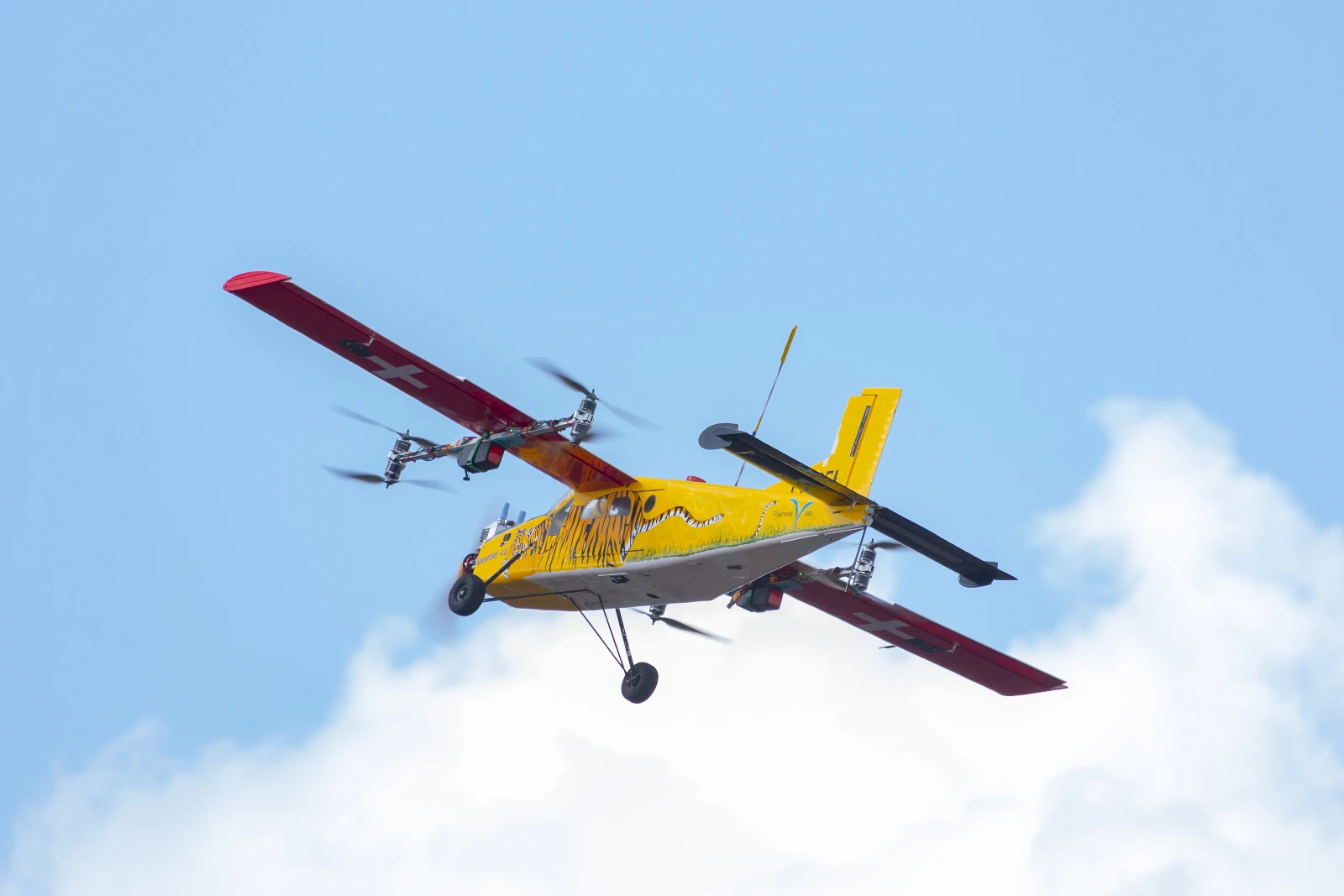
▲ VTOL aircraft supported by Plane firmware (QuadPlane)
Pros and cons of a fixed wing
Advantages
- Long endurance, long range: the wing makes the lift, so thrust only has to overcome drag. For the same takeoff weight a fixed wing typically flies 3~6 times longer than a multirotor, and the range gap is wider still.
- Fast cruise: typical cruise speed is 15~25 m/s, covering far more ground per hour.
- High payload fraction: the wing carries the lift and structure is a small share of the weight, so the same platform can carry more battery, fuel or payload.
- Good wind tolerance: high wing loading and high inertia mean gusts and turbulence affect the cruise phase less than they affect a multirotor.
- Something left to glide on: with power lost it can still glide down; a multirotor without power simply falls.
- Quiet and low infrared signature in cruise: an electric fixed wing is almost silent while gliding.
Drawbacks
- Takeoff and landing depend on a site or a launcher: it needs a runway, a catapult, a hand launch or a parachute recovery — not any patch of open ground.
- No hovering: no hold-a-point capability, no slow work close to the ground, and no taking off in tight spaces.
- Risk concentrates at takeoff and landing: stalls, wingtip strikes, catapult shocks and hard parachute landings all happen in that phase.
- Poor manoeuvrability: wide turning radius, weak obstacle avoidance and circling in low or cluttered terrain.
- Steep learning curve: the pilot has to master launch and recovery, airspeed management and the stall margin, and training takes longer than for a multirotor; site survey, catapult or runway preparation also needs a dedicated person.
- Many things to get right when tuning: centre of gravity, control-surface direction, airspeed sensor calibration, stall behaviour, pitch trim — any one wrong and the aircraft is destroyed.
- High speed means expensive single accidents: impact energy is large, and airframe and payload are often a total loss.
What VTOL adds
VTOL (QuadPlane in ArduPilot) adds a set of multirotor propulsion to a fixed wing: multirotor mode for takeoff and landing, fixed-wing mode for cruise. That is also why a VTOL fixed wing is sometimes called a compound wing.
- No airfield needed: vertical takeoff and landing, no runway, catapult or parachute recovery — a few square metres of flat ground will do.
- Hovering comes back: it can hold a point over a work site, observe slowly, and take off in confined spaces.
- Better control in the takeoff and landing phase: at low speed the multirotor propulsion controls attitude, so wind tolerance and position accuracy approach those of a multirotor.
- Simpler operations: one site covers both takeoff and transit, which makes mountains, forests and boat decks usable.
- Keeps the fixed-wing cruise efficiency: the wing still makes the lift in cruise, so endurance and range stay far above a pure multirotor.
What VTOL costs
Hovering is not free. The cost shows up in weight, drag, money and reliability.
- Dead structure weight: four (or more) VTOL motors, props, booms and ESCs do nothing during cruise and are pure dead weight.
- More cruise drag: booms and stopped props add drag, so cruise efficiency is below a pure fixed wing of the same size and endurance is typically 15%~30% lower. Top speed is usually lower than an equivalent fixed wing as well.
- Cost close to double: twice the propulsion systems and a more complex frame and connector set make purchase and maintenance more expensive than a pure fixed wing.
- More complex tuning: on top of the fixed-wing parameters there is a whole
Q_set (Q_ENABLE,Q_FRAME_CLASS,Q_TRANSITION_MS,Q_ASSIST_SPEEDand so on), and the transition has to be flight-tested separately. - Transitions are where accidents cluster: losing height on the forward transition, odd attitudes on the back transition — most VTOL accidents happen in those ten-odd seconds.
- Harder to handle a failure: a pure fixed wing can glide without power; a VTOL that loses its lift motors while hovering falls straight down, and both propulsion systems have to be reliable on their own.
- Harder to transport and deploy: booms are usually detachable, there are more connectors, and field preparation takes longer.
Comparing the three layouts
| Dimension | Multirotor | Fixed wing | VTOL |
|---|---|---|---|
| Takeoff and landing site | Any flat ground | Runway, catapult or parachute | A few square metres |
| Hovering | Yes | No | Yes (multirotor mode) |
| Cruise efficiency | Low | High | Close to fixed wing, slightly lower |
| Endurance | 20~40 min | 1~3 h | 40 min~2 h |
| Payload fraction | Low | High | Medium |
| Wind tolerance in cruise | Medium | Good | Good |
| Tuning complexity | Low | Medium | High |
| Cost per aircraft | Low | Medium | High |
| Failure outcome | Falls | Can glide | Glides in cruise, falls while hovering |
Choosing a layout
- Long endurance, large-area mapping and inspection, and you have a site: fixed wing. Highest efficiency, lowest cost.
- No runway but you need endurance: VTOL. The standard choice for mountains, forests, boats and emergency work.
- Fine work at a fixed point, short range, indoors or confined: multirotor.
- Small operating radius but takeoff on demand: multirotor. VTOL dead weight and tuning cost do not pay off here.
Further reading
- Loading Plane firmware: Writing ArduPilot firmware
- CUAV fixed-wing tutorial: https://doc.cuav.net/tutorial/plane/
- CUAV VTOL tutorial: https://doc.cuav.net/tutorial/quadplane/zh-hans/
- Official ArduPilot Plane documentation: https://ardupilot.org/plane/