

Mounting the Controller and Accessories
The parts list is in the required parts section of the rover guide. The controller goes in first — everything after it depends on where and which way it faces. Mounting has two steps: fix the controller to the frame in the right orientation, then wire the motors and servos to the right outputs for your chassis type.
Position and orientation
Point the arrow on the controller towards the front of the vehicle, and keep it as close as possible to the centre of gravity both horizontally and vertically: within a few centimetres of the middle, roughly level with the motors. It still works if it ends up slightly off centre; set the IMU mounting offset parameters to compensate when the offset is obvious.
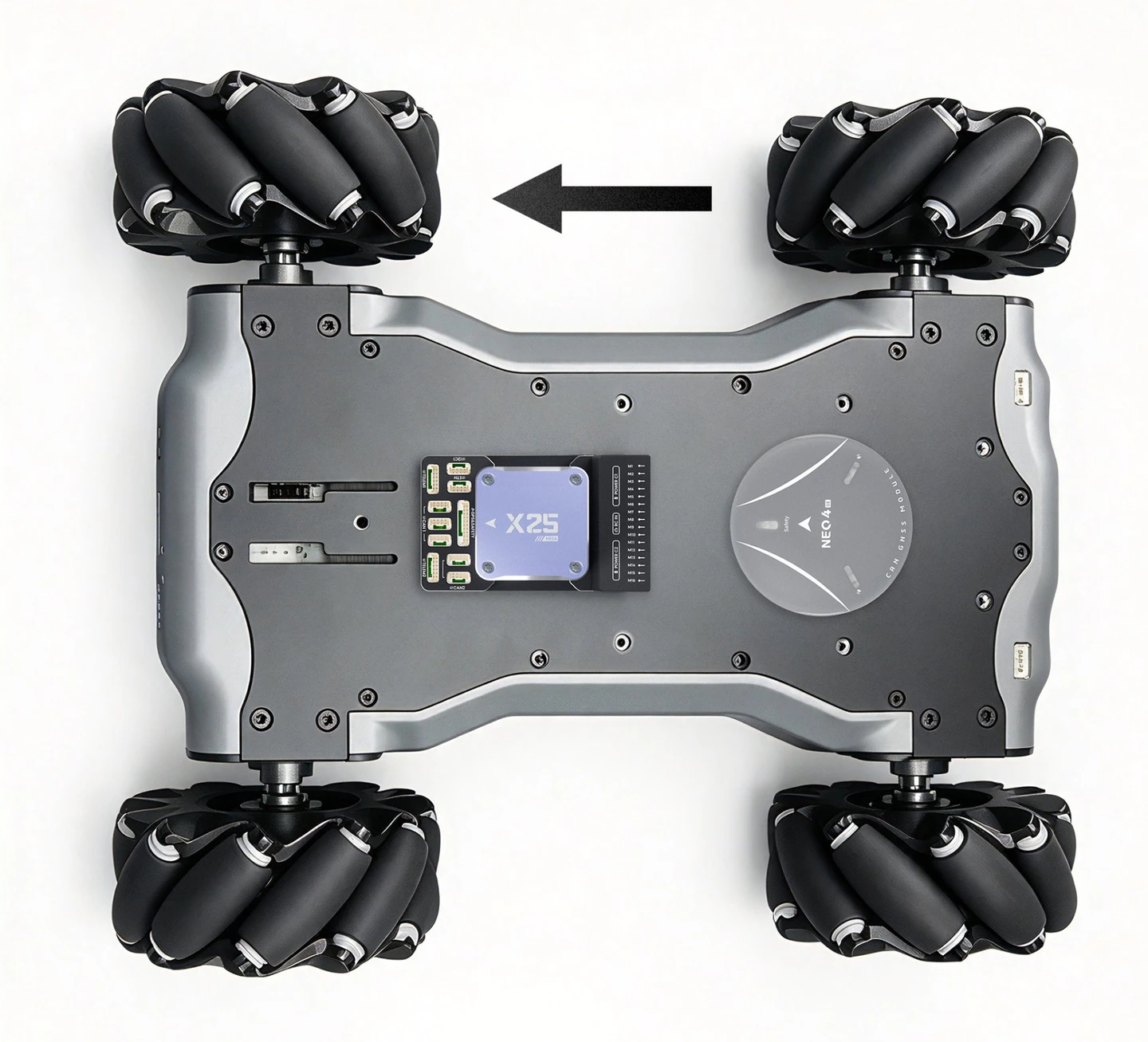
▲ X25 MEGA and NEO 4 both sit mid-frame; the arrow points to the front
Stick the board to the frame with four pieces of foam about 3/4 inch square, one at each corner. Do not bolt it down hard.
Tip
Foam is the easiest and most effective damping there is. If vibration measurement still looks bad, move on to the other methods on the official Vibration Damping page.
Other mounting orientations
When space does not allow the standard orientation, AHRS_ORIENTATION offers more than thirty alternatives. Find Board Orientation in the ground station under Config/Tuning → Advanced Params and read the table below for what the sign of each axis means.
| Value | Meaning |
|---|---|
| Roll90 | Board stood up 90° to the right; the white arrow still points forward |
| Pitch90 | Board tilted 90° nose up; the arrow points straight up |
| Yaw90 | Board rotated 90° clockwise; the arrow points to the right side of the vehicle |
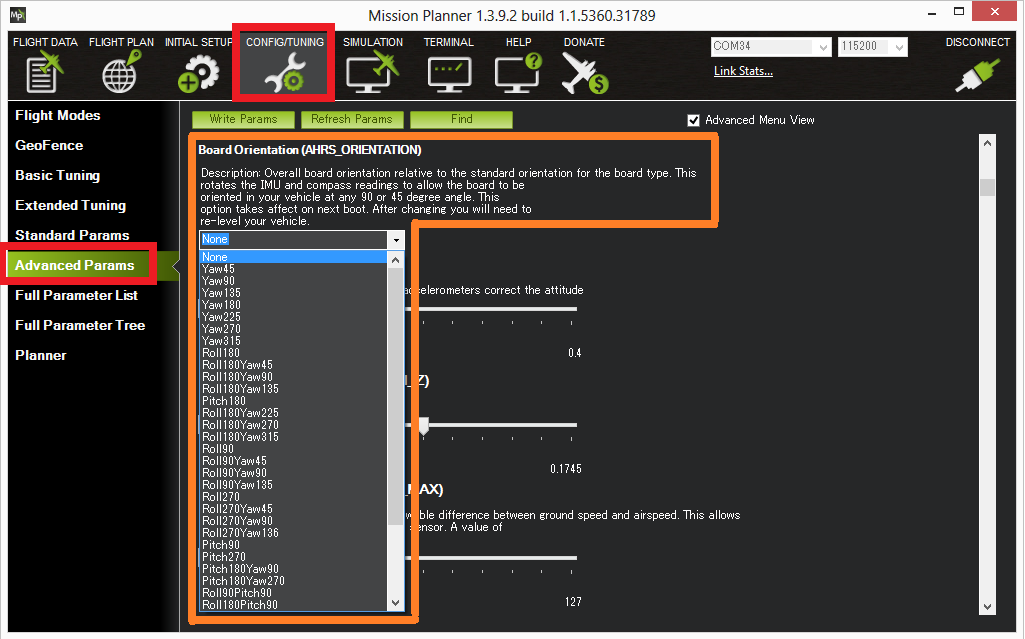
▲ Pick Board Orientation under Advanced Params in the ground station
Set the orientation before calibrating
If the arrow does not point forward, set AHRS_ORIENTATION first and calibrate the accelerometer afterwards. Do it the other way round and the calibration produces a wrong attitude.
Motors, servos and encoders
The three chassis types wire up differently: Ackermann uses a steering servo plus an ESC, a differential vehicle has one motor channel per side, and an omnidirectional vehicle has four motor channels. How channel numbers map to parameters is covered in Motor and servo connections.
Add wheel encoder setup if you want odometry, or need to estimate position without GPS.